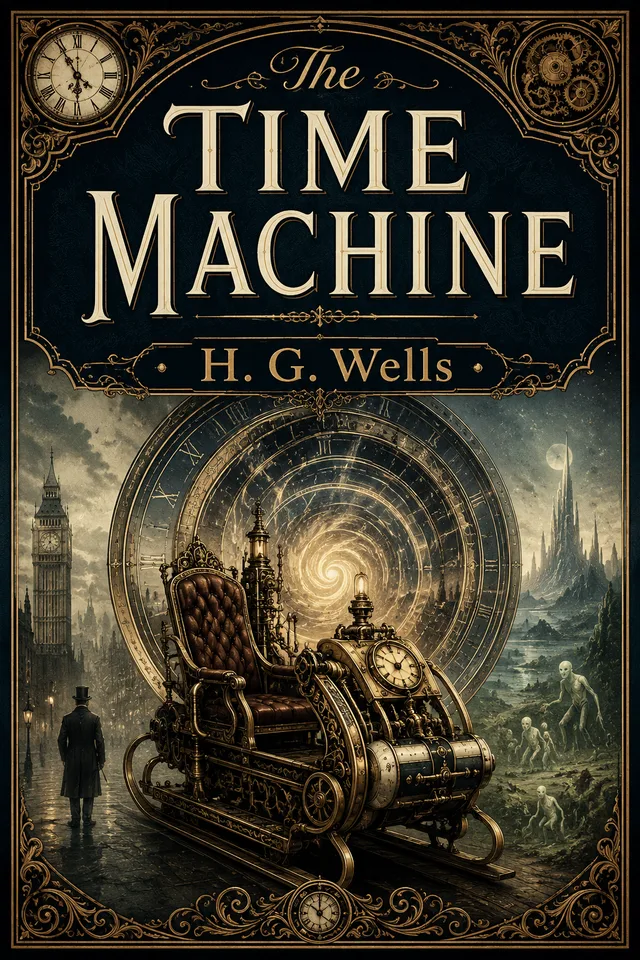
English Edition
Literature
The Time Machine
English BooksWhale Edition by H. G. Wells
A foundational science-fiction novella about time travel, class, evolution, and the far future.
- Preview
- A sample from the prepared text
- Formats
- Online reader, EPUB, PDF
- Access
- Library claim
Book introduction
The Time Machine
The Time Machine sends a Victorian inventor into a distant future shaped by social division and evolutionary change. Wells turns speculative invention into a sharp vision of humanity’s possible fate.
BooksWhale edition
How this edition was prepared
This edition is based on a public domain text and has been prepared for digital reading by BooksWhale.
Public domain basis
Why this edition can be shared
H. G. Wells died in 1946, and The Time Machine was first published in 1895; these dates support the public-domain basis for this English edition.
Read preview
A sample from the prepared text
Preview selected from the prepared reader text.
Preview chapterFull textRead preview
The Time Machine
H. G. Wells
Preview chapterI. IntroductionPreview
The Time Traveller (for so it will be convenient to speak of him) was expounding a recondite matter to us. His grey eyes shone and twinkled, and his usually pale face was flushed and animated. The fire burnt brightly, and the soft radiance of the incandescent lights in the lilies of silver caught the bubbles that flashed and passed in our glasses. Our chairs, being his patents, embraced and caressed us rather than submitted to be sat upon, and there was that luxurious after-dinner atmosphere, when thought runs gracefully free of the trammels of precision. And he put it to us in this way—marking the points with a lean forefinger—as we sat and lazily admired his earnestness over this new paradox (as we thought it) and his fecundity.
“You must follow me carefully. I shall have to controvert one or two ideas that are almost universally accepted. The geometry, for instance, they taught you at school is founded on a misconception.”
“Is not that rather a large thing to expect us to begin upon?” said Filby, an argumentative person with red hair.
“I do not mean to ask you to accept anything without reasonable ground for it. You will soon admit as much as I need from you. You know of course that a mathematical line, a line of thickness nil, has no real existence. They taught you that? Neither has a mathematical plane. These things are mere abstractions.”
“That is all right,” said the Psychologist.
“Nor, having only length, breadth, and thickness, can a cube have a real existence.”
“There I object,” said Filby. “Of course a solid body may exist. All real things—”
“So most people think. But wait a moment. Can an instantaneous cube exist?”
“Don’t follow you,” said Filby.
“Can a cube that does not last for any time at all, have a real existence?”
Filby became pensive. “Clearly,” the Time Traveller proceeded, “any real body must have extension in four directions: it must have Length, Breadth, Thickness, and—Duration. But through a natural infirmity of the flesh, which I will explain to you in a moment, we incline to overlook this fact. There are really four dimensions, three which we call the three planes of Space, and a fourth, Time. There is, however, a tendency to draw an unreal distinction between the former three dimensions and the latter, because it happens that our consciousness moves intermittently in one direction along the latter from the beginning to the end of our lives.”
“That,” said a very young man, making spasmodic efforts to relight his cigar over the lamp; “that... very clear indeed.”
“Now, it is very remarkable that this is so extensively overlooked,” continued the Time Traveller, with a slight accession of cheerfulness. “Really this is what is meant by the Fourth Dimension, though some people who talk about the Fourth Dimension do not know they mean it. It is only another way of looking at Time. There is no difference between Time and any of the three dimensions of Space except that our consciousness moves along it. But some foolish people have got hold of the wrong side of that idea. You have all heard what they have to say about this Fourth Dimension?”
“I have not,” said the Provincial Mayor.
“It is simply this. That Space, as our mathematicians have it, is spoken of as having three dimensions, which one may call Length, Breadth, and Thickness, and is always definable by reference to three planes, each at right angles to the others. But some philosophical people have been asking why three dimensions particularly—why not another direction at right angles to the other three?—and have even tried to construct a Four-Dimensional geometry. Professor Simon Newcomb was expounding this to the New York Mathematical Society only a month or so ago. You know how on a flat surface, which has only two dimensions, we can represent a figure of a three-dimensional solid, and similarly they think that by models of three dimensions they could represent one of four—if they could master the perspective of the thing. See?”
Preview chapterII. The MachinePreview
The thing the Time Traveller held in his hand was a glittering metallic framework, scarcely larger than a small clock, and very delicately made. There was ivory in it, and some transparent crystalline substance. And now I must be explicit, for this that follows—unless his explanation is to be accepted—is an absolutely unaccountable thing. He took one of the small octagonal tables that were scattered about the room, and set it in front of the fire, with two legs on the hearthrug. On this table he placed the mechanism. Then he drew up a chair, and sat down. The only other object on the table was a small shaded lamp, the bright light of which fell full upon the model. There were also perhaps a dozen candles about, two in brass candlesticks upon the mantel and several in sconces, so that the room was brilliantly illuminated. I sat in a low arm-chair nearest the fire, and I drew this forward so as to be almost between the Time Traveller and the fireplace. Filby sat behind him, looking over his shoulder. The Medical Man and the Provincial Mayor watched him in profile from the right, the Psychologist from the left. The Very Young Man stood behind the Psychologist. We were all on the alert. It appears incredible to me that any kind of trick, however subtly conceived and however adroitly done, could have been played upon us under these conditions.
The Time Traveller looked at us, and then at the mechanism. “Well?” said the Psychologist.
“This little affair,” said the Time Traveller, resting his elbows upon the table and pressing his hands together above the apparatus, “is only a model. It is my plan for a machine to travel through time. You will notice that it looks singularly askew, and that there is an odd twinkling appearance about this bar, as though it was in some way unreal.” He pointed to the part with his finger. “Also, here is one little white lever, and here is another.”
The Medical Man got up out of his chair and peered into the thing. “It’s beautifully made,” he said.
“It took two years to make,” retorted the Time Traveller. Then, when we had all imitated the action of the Medical Man, he said: “Now I want you clearly to understand that this lever, being pressed over, sends the machine gliding into the future, and this other reverses the motion. This saddle represents the seat of a time traveller. Presently I am going to press the lever, and off the machine will go. It will vanish, pass into future Time, and disappear. Have a good look at the thing. Look at the table too, and satisfy yourselves there is no trickery. I don’t want to waste this model, and then be told I’m a quack.”
There was a minute’s pause perhaps. The Psychologist seemed about to speak to me, but changed his mind. Then the Time Traveller put forth his finger towards the lever. “No,” he said suddenly. “Lend me your hand.” And turning to the Psychologist, he took that individual’s hand in his own and told him to put out his forefinger. So that it was the Psychologist himself who sent forth the model Time Machine on its interminable voyage. We all saw the lever turn. I am absolutely certain there was no trickery. There was a breath of wind, and the lamp flame jumped. One of the candles on the mantel was blown out, and the little machine suddenly swung round, became indistinct, was seen as a ghost for a second perhaps, as an eddy of faintly glittering brass and ivory; and it was gone—vanished! Save for the lamp the table was bare.
Everyone was silent for a minute. Then Filby said he was damned.
The Psychologist recovered from his stupor, and suddenly looked under the table. At that the Time Traveller laughed cheerfully. “Well?” he said, with a reminiscence of the Psychologist. Then, getting up, he went to the tobacco jar on the mantel, and with his back to us began to fill his pipe.
Table of contents
Inside this edition
- 01Full text
- 02I. Introduction
- 03II. The Machine
- 04III. The Time Traveller Returns
- 05IV. Time Travelling
- 06V. In the Golden Age
- 07VI. The Sunset of Mankind
- 08VII. A Sudden Shock
- 09VIII. Explanation
- 10IX. The Morlocks
- 11X. When Night Came
- 12XI. The Palace of Green Porcelain
- 13XII. In the Darkness
- 14XIII. The Trap of the White Sphinx
- 15XIV. The Further Vision
- 16XV. The Time Traveller’s Return
- 17XVI. After the Story
- 18Epilogue
Language availability
Other languages
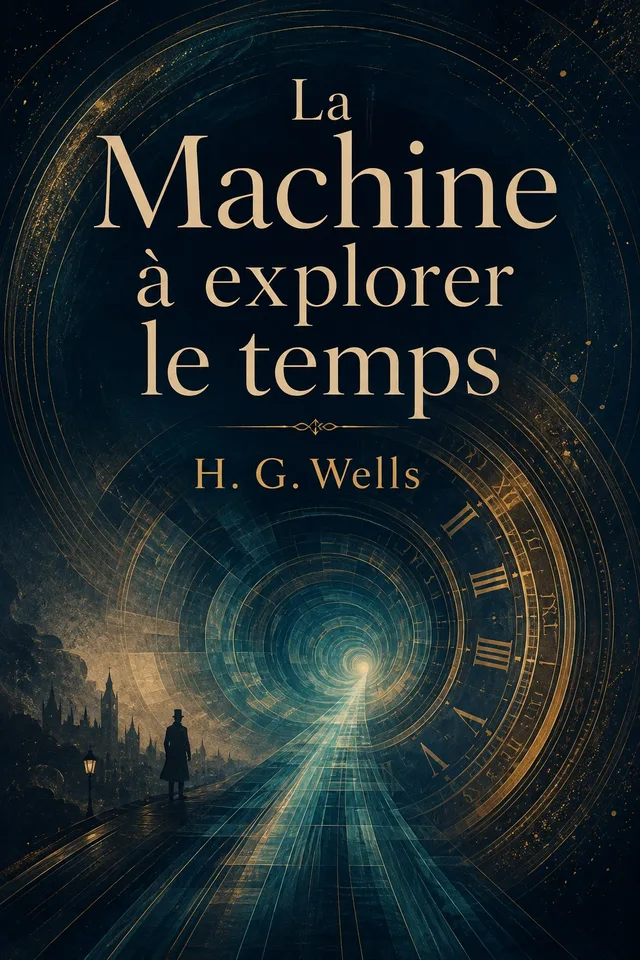
French
French Edition
La Machine à explorer le temps
H. G. Wells · Literature
Un classique de science-fiction sur le voyage temporel, l’avenir lointain et le destin de l’humanité.
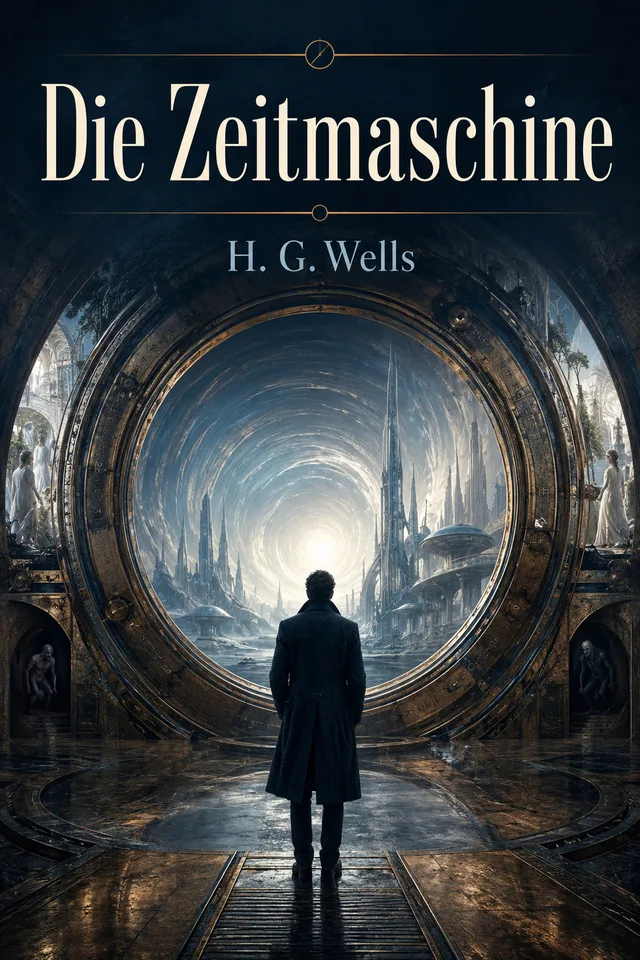
German
German Edition
Die Zeitmaschine
H. G. Wells · Literature
Deutsche Ausgabe von H. G. Wells’ Science-Fiction-Klassiker über Zeitreise, ferne Zukunft, Eloi, Morlocks und Gesellschaftskritik.