English Edition
Literature
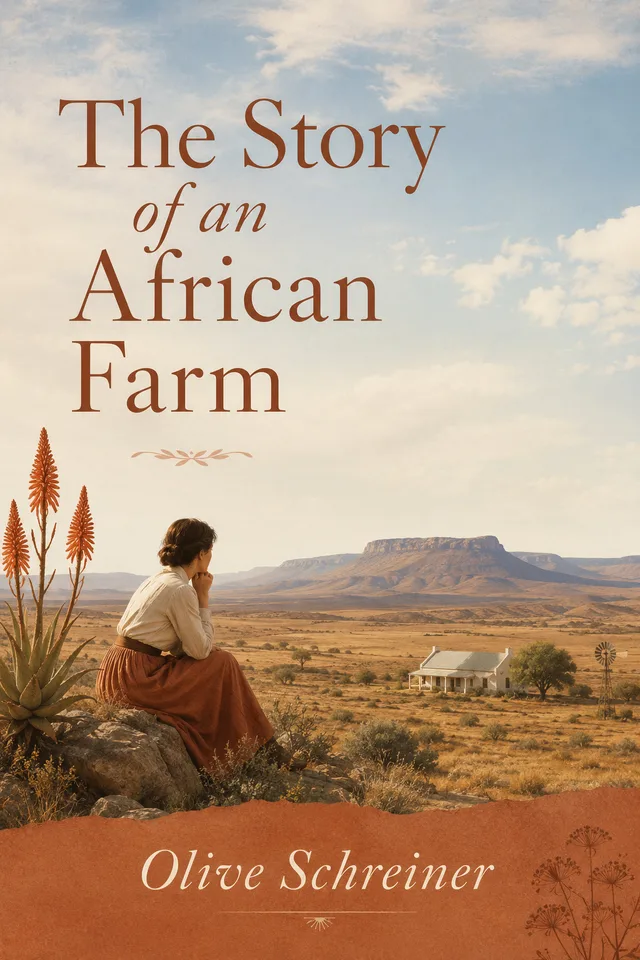
The Story of an African Farm
English BooksWhale Edition by Olive Schreiner
A South African literary classic about childhood, gender, belief, freedom, and colonial life.
- Preview
- A sample from the prepared text
- Formats
- Online reader, EPUB, PDF
- Access
- Library claim
Book introduction
The Story of an African Farm
The Story of an African Farm follows Lyndall, Waldo, and Em through youth, longing, spiritual doubt, and the constraints of colonial society. Schreiner’s novel is admired for its feminist force, philosophical questioning, and vivid Karoo setting.
BooksWhale edition
How this edition was prepared
This edition is based on a public domain text and has been prepared for digital reading by BooksWhale.
Public domain basis
Why this edition can be shared
Olive Schreiner died in 1920, and The Story of an African Farm was first published in 1883; these dates support the public-domain basis for this original-language English edition.
Read preview
A sample from the prepared text
Preview selected from the prepared reader text.
Preview chapterFull textRead preview
The Story of an African Farm
Olive Schreiner
Preface.
I have to thank cordially the public and my critics for the reception they have given this little book.
Dealing with a subject that is far removed from the round of English daily life, it of necessity lacks the charm that hangs about the ideal representation of familiar things, and its reception has therefore been the more kindly.
A word of explanation is necessary. Two strangers appear on the scene, and some have fancied that in the second they have again the first, who returns in a new guise. Why this should be we cannot tell; unless there is a feeling that a man should not appear upon the scene, and then disappear, leaving behind him no more substantial trace than a mere
Preview chapterbook; that he should return later on as husband or lover, to fill somePreview
more important part than that of the mere stimulator of thought.
Human life may be painted according to two methods. There is the stage method. According to that each character is duly marshalled at first, and ticketed; we know with an immutable certainty that at the right crises each one will reappear and act his part, and, when the curtain falls, all will stand before it bowing. There is a sense of satisfaction in this, and of completeness. But there is another method--the method of the life we all lead. Here nothing can be prophesied. There is a strange coming and going of feet. Men appear, act and re-act upon each other, and pass away. When the crisis comes the man who would fit it does not return. When the curtain falls no one is ready. When the footlights are brightest they are blown out; and what the name of the play is no one knows. If there sits a spectator who knows, he sits so high that the players in the gaslight cannot hear his breathing. Life may be painted according to either method; but the methods are different. The canons of criticism that bear upon the one cut cruelly upon the other.
It has been suggested by a kind critic that he would better have liked the little book if it had been a history of wild adventure; of cattle driven into inaccessible kranzes by Bushmen; “of encounters with ravening lions, and hair-breadth escapes.” This could not be. Such works are best written in Piccadilly or in the Strand: there the gifts of the creative imagination, untrammelled by contact with any fact, may spread their wings.
But, should one sit down to paint the scenes among which he has grown, he will find that the facts creep in upon him. Those brilliant phases and shapes which the imagination sees in far-off lands are not for him to portray. Sadly he must squeeze the colour from his brush, and dip it into the gray pigments around him. He must paint what lies before him.
R. Iron.
“We must see the first images which the external world casts upon the dark mirror of his mind; or must hear the first words which awaken the sleeping powers of thought, and stand by his earliest efforts, if we would understand the prejudices, the habits, and the passions that will rule his life. The entire man is, so to speak, to be found in the cradle of the child.”
Alexis de Tocqueville.
Glossary.
Several Dutch and Colonial words occurring in this work, the subjoined Glossary is given, explaining the principal.
Alle wereld!--Gosh! Aasvogels--Vultures. Benauwdheid--Indigestion. Brakje--A little cur of low degree. Bultong--Dried meat. Coop--Hide and Seek. Inspan--To harness. Kapje--A sun-bonnet. Karoo--The wide sandy plains in some parts of South Africa. Karoo-bushes--The bushes that take the place of grass on these plains. Kartel--The wooden-bed fastened in an ox-wagon. Kloof--A ravine. Kopje--A small hillock, or “little head.” Kraal--The space surrounded by a stone wall or hedged with thorn branches, into which sheep or cattle are driven at night. Mealies--Indian corn. Meerkat--A small weazel-like animal. Meiboss--Preserved and dried apricots. Nachtmaal--The Lord’s Supper. Oom--Uncle. Outspan--To unharness, or a place in the field where one unharnesses. Pap--Porridge. Predikant--Parson. Riem--Leather rope. Sarsarties--Food. Sleg--Bad. Sloot--A dry watercourse. Spook--To haunt, a ghost. Stamp-block--A wooden block, hollowed out, in which mealies are placed to be pounded before being cooked. Stoep--Porch. Tant or Tante--Aunt. Upsitting--In Boer courtship the man and girl are supposed to sit up together the whole night. Veld--Open country. Velschoen--Shoes of undressed leather. Vrijer--Available man.
Contents.
Preview chapterPart I.Preview
Part I.
Table of contents
Inside this edition
- 01Full text
- 02book; that he should return later on as husband or lover, to fill some
- 03Part I.
- 04Chapter 1.I. Shadows From Child Life.
- 05Chapter 1.II. Plans and Bushman Paintings.
- 06Chapter 1.III. I Was A Stranger, and Ye Took Me In.
- 07Chapter 1.IV. Blessed is He That Believeth.
- 08Chapter 1.V. Sunday Services.
- 09Chapter 1.VI. Bonaparte Blenkins Makes His Nest.
- 10Chapter 1.VII. He Sets His Trap.
- 11Chapter 1.VIII. He Catches the Old Bird.
- 12Chapter 1.IX. He Sees A Ghost.
- 13Chapter 1.X. He Shows His Teeth.
- 14Chapter 1.XI. He Snaps.
- 15Chapter 1.XII. He Bites.
- 16Chapter 1.XIII. He Makes Love.
- 17Part II.
- 18Chapter 2.I. Times and Seasons.
- 19Chapter 2.II. Waldo’s Stranger.
- 20Chapter 2.III. Gregory Rose Finds His Affinity.
- 21Chapter 2.IV. Lyndall.
- 22Chapter 2.V. Tant Sannie Holds An Upsitting, and Gregory Writes A Letter.
- 23Chapter 2.VI. A Boer-wedding.
- 24Chapter 2.VII. Waldo Goes Out to Taste Life, and Em Stays At Home and
- 25Chapter 2.VIII. The Kopje.
- 26Chapter 2.IX. Lyndall’s Stranger.
- 27Chapter 2.X. Gregory Rose Has An Idea.
- 28Chapter 2.XI. An Unfinished Letter.
- 29Chapter 2.XII. Gregory’s Womanhood.
- 30Chapter 2.XIII. Dreams.
- 31Chapter 2.XIV. Waldo Goes Out to Sit in the Sunshine.
- 32THE STORY OF AN AFRICAN FARM
- 33Part I.
- 34Chapter 1.I. Shadows From Child-Life.
- 35Chapter 1.II. Plans and Bushman Paintings.
- 36Chapter 1.III. I Was A Stranger, and Ye Took Me In.
- 37Chapter 1.IV. Blessed is He That Believeth.
- 38Chapter 1.V. Sunday Services.
- 39book of the Lord, and no voice cry out it was a mean and dastardly sin
- 40Chapter 1.VI. Bonaparte Blenkins Makes His Nest.
- 41Chapter 1.VII. He Sets His Trap.
- 42Chapter 1.VIII. He Catches the Old Bird.
- 43“O.F.”
- 44Chapter 1.IX. He Sees A Ghost.
- 45Chapter 1.X. He Shows His Teeth.
- 46Chapter 1.XI. He Snaps.
- 47Chapter 1.XII. He Bites.
- 48book, Bonaparte and the broken machine, the box in the loft, he himself
- 49Chapter 1.XIII. He Makes Love.
- 50PART II.
- 51Chapter 2.I. Times and Seasons.
- 52I.
- 53II.
- 54III.
- 55chapter of Matthew, and read it all through. It is a new gold-mine. Then
- 56IV.
- 57chapter in the prophets, telling how the chosen people of God shall
- 58V.
- 59VI.
- 60VII.
- 61Chapter 2.II. Waldo’s Stranger.
- 62part of the fellow, which brought him close to the stranger’s feet. Soon
- 63book into his breast, and while he saddled the horse the stranger made
- 64Chapter 2.III. Gregory Rose Finds His Affinity.
- 65“G.N.R.”
- 66Chapter 2.IV. Lyndall.
- 67Chapter 2.V. Tant Sannie Holds An Upsitting, and Gregory Writes A
- 68Chapter 2.VI. A Boer-wedding.
- 69Chapter 2.VII. Waldo Goes Out to Taste Life, and Em Stays At Home and
- 70Chapter 2.VIII. The Kopje.
- 71Chapter 2.IX. Lyndall’s Stranger.
- 72part that you know nothing of, that you never touch. If I married
- 73Chapter 2.X. Gregory Rose Has An Idea.
- 74Chapter 2.XI. An Unfinished Letter.
- 75book, but nothing more. The old black hat had a piece of unhemmed muslin
- 76Chapter 2.XII. Gregory’s Womanhood.
- 77book,” she said; “I can hold it for myself.”
- 78book; but the words are merely strung together, they make no sense.
- 79Chapter 2.XIII. Dreams.
- 80Chapter 2.XIV. Waldo Goes Out to Sit in the Sunshine.
Language availability
Other languages
Additional language editions are not published yet. This section will link to other BooksWhale editions when they become available.
Request another language