English Edition
Literature
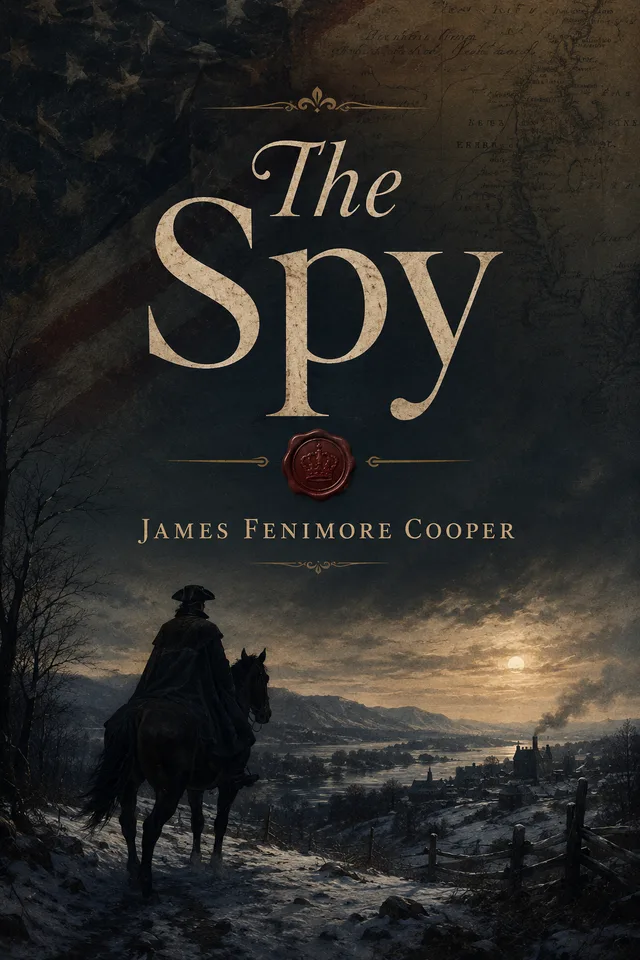
The Spy
English BooksWhale Edition by James Fenimore Cooper
A Revolutionary War novel of espionage, divided loyalties, patriotism, and secret sacrifice.
- Preview
- A sample from the prepared text
- Formats
- Online reader, EPUB, PDF
- Access
- Library claim
Book introduction
The Spy
The Spy turns the American Revolution into a tense story of disguise, intelligence work, family loyalty, and uncertain allegiance. Cooper’s Harvey Birch moves through occupied territory as a figure of suspicion and courage, making the novel an early landmark of American historical fiction.
BooksWhale edition
How this edition was prepared
This edition is based on a public domain text and has been prepared for digital reading by BooksWhale.
Public domain basis
Why this edition can be shared
The Spy is a public-domain work: the author died in 1851, and the text was first published in 1821. This edition uses the original English text.
Read preview
A sample from the prepared text
Preview selected from the prepared reader text.
Preview chapterThe SpyRead preview
ECLECTIC ENGLISH CLASSICS
THE SPY
A TALE OF THE NEUTRAL GROUND
BY JAMES FENIMORE COOPER
EDITED BY
NATHANIEL WARING BARNES
PROFESSOR OF ENGLISH COMPOSITION
IN DE PAUW UNIVERSITY
GREENCASTLE, INDIANA
JAMES FENIMORE COOPER
"I believe I could write a better story myself!" With these words, since
become famous, James Fenimore Cooper laid aside the English novel which
he was reading aloud to his wife. A few days later he submitted several
pages of manuscript for her approval, and then settled down to the task
of making good his boast. In November, 1820, he gave the public a novel
in two volumes, entitled _Precaution_. But it was published anonymously,
and dealt with English society in so much the same way as the average
British novel of the time that its author was thought by many to be an
Englishman. It had no originality and no real merit of any kind. Yet it
was the means of inciting Cooper to another attempt. And this second
novel made him famous.
When _Precaution_ appeared, some of Cooper's friends protested against
his weak dependence on British models. Their arguments stirred his
patriotism, and he determined to write another novel, using thoroughly
American material. Accordingly he turned to Westchester County, where he
was then living, a county which had been the scene of much stirring
action during a good part of the Revolutionary War, and composed _The
Spy--A Tale of the Neutral Ground_. This novel was published in 1821,
and was immediately popular, both in this country and in England. Soon
it was translated into French, then into other foreign languages, until
it was read more widely than any other tale of the century. Cooper had
written the first American novel. He had also struck an original
literary vein, and he had gained confidence in himself as a writer.
Following this pronounced success in authorship, Cooper set to work on a
third book and continued for the remainder of his life to devote most of
his time to writing. Altogether he wrote over thirty novels and as many
more works of a miscellaneous character. But much of this writing has no
interest for us at the present time, especially that which was
occasioned by the many controversies in which the rather belligerent
Cooper involved himself. His work of permanent value after _The Spy_
falls into two groups, the tales of wilderness life and the sea tales.
Both these groups grew directly out of his experiences in early life.
Cooper was born on September 15, 1789, in Burlington, New Jersey, but
while still very young he was taken to Cooperstown, on the shores of
Otsego Lake, in central New York. His father owned many thousand acres
of primeval forest about this village, and so through the years of a
free boyhood the young Cooper came to love the wilderness and to know
the characters of border life. When the village school was no longer
adequate, he went to study privately in Albany and later entered Yale
College. But he was not interested in the study of books. When, as a
junior, he was expelled from college, he turned to a career in the navy.
Accordingly in the fall of 1806 he sailed on a merchant ship, the
_Sterling_, and for the next eleven months saw hard service before the
mast. Soon after this apprenticeship he received a commission as a
midshipman in the United States navy. Although it was a time of peace,
and he saw no actual fighting, he gained considerable knowledge from his
service on Lake Ontario and Lake Champlain that he put to good use
later. Shortly before his resignation in May, 1811, he had married, and
for several years thereafter he lived along in a pleasant, leisurely
fashion, part of the time in Cooperstown and part of the time in
Westchester County, until almost accidentally he broke into the writing
of his first novel. Aside from the publication of his books, Cooper's
Preview chapterCHAPTER IPreview
And though amidst the calm of thought entire,
Some high and haughty features might betray
A soul impetuous once--'twas earthly fire
That fled composure's intellectual ray,
As Etna's fires grow dim before the rising day.
--Gertrude of Wyoming.
It was near the close of the year 1780 that a solitary traveler was seen
pursuing his way through one of the numerous little valleys of
Westchester. [Footnote: As each state of the American Union has its own
counties, it often happens that there are several which bear the same
name. The scene of this tale is in New York, whose county of Westchester
is the nearest adjoining to the city.] The easterly wind, with its
chilling dampness and increasing violence, gave unerring notice of the
approach of a storm, which, as usual, might be expected to continue for
several days; and the experienced eye of the traveler was turned in
vain, through the darkness of the evening, in quest of some convenient
shelter, in which, for the term of his confinement by the rain that
already began to mix with the atmosphere in a thick mist, he might
obtain such accommodations as his purposes required. Nothing whatever
offered but the small and inconvenient tenements of the lower order of
the inhabitants, with whom, in that immediate neighborhood, he did not
think it either safe or politic to trust himself.
The county of Westchester, after the British had obtained possession of
the island of New York, [Footnote: The city of New York is situated on
an island called Manhattan: but it is at one point separated from the
county of Westchester by a creek of only a few feet in width. The bridge
at this spot is called King's Bridge. It was the scene of many
skirmishes during the war, and is alluded to in this tale. Every
Manhattanese knows the difference between "Manhattan Island" and the
"island of Manhattan." The first is applied to a small District in the
vicinity of Corlaer's Hook, while the last embraces the Whole island; or
the city and county of New York as it is termed in the laws.] became
common ground, in which both parties continued to act for the remainder
of the war of the Revolution. A large proportion of its inhabitants,
either restrained by their attachments, or influenced by their fears,
affected a neutrality they did not feel. The lower towns were, of
course, more particularly under the dominion of the crown, while the
upper, finding a security from the vicinity of the continental troops,
were bold in asserting their revolutionary opinions, and their right to
govern themselves. Great numbers, however, wore masks, which even to
this day have not been thrown aside; and many an individual has gone
down to the tomb, stigmatized as a foe to the rights of his countrymen,
while, in secret, he has been the useful agent of the leaders of the
Revolution; and, on the other hand, could the hidden repositories of
divers flaming patriots have been opened to the light of day, royal
protections would have been discovered concealed under piles of
British gold.
At the sound of the tread of the noble horse ridden by the traveler, the
mistress of the farmhouse he was passing at the time might be seen
cautiously opening the door of the building to examine the stranger; and
perhaps, with an averted face communicating the result of her
observations to her husband, who, in the rear of the building, was
prepared to seek, if necessary, his ordinary place of concealment in the
adjacent woods. The valley was situated about midway in the length of
the county, and was sufficiently near to both armies to make the
restitution of stolen goods no uncommon occurrence in that vicinity. It
is true, the same articles were not always regained; but a summary
substitute was generally resorted to, in the absence of legal justice,
Preview chapterCHAPTER IIPreview
And many a halcyon day he lived to see
Unbroken, but by one misfortune dire,
When fate had reft his mutual heart--but she
Was gone-and Gertrude climbed a widowed father's knee.
--Gertrude of Wyoming.
The father of Mr. Wharton was a native of England, and of a family whose
parliamentary interest had enabled them to provide for a younger son in
the colony of New York. The young man, like hundreds of others in this
situation, had settled permanently in the country. He married; and the
sole issue of his connection had been sent early in life to receive the
benefits of the English schools. After taking his degrees at one of the
universities of the mother country, the youth had been suffered to
acquire a knowledge of life with the advantages of European society. But
the death of his father recalled him, after passing two years in this
manner, to the possession of an honorable name, and a very ample estate.
It was much the fashion of that day to place the youth of certain
families in the army and navy of England, as the regular stepping-stones
to preferment. Most of the higher offices in the colonies were filled by
men who had made arms their profession; and it was even no uncommon
sight to see a veteran warrior laying aside the sword to assume the
ermine on the benches of the highest judicial authority.
In conformity with this system, the senior Mr. Wharton had intended his
son for a soldier; but a natural imbecility of character in his child
interfered with his wishes.
A twelvemonth had been spent by the young man in weighing the
comparative advantages of the different classes of troops, when the
death of his father occurred. The ease of his situation, and the
attentions lavished upon a youth in the actual enjoyment of one of the
largest estates in the colonies, interfered greatly with his ambitious
projects. Love decided the matter; and Mr. Wharton, in becoming a
husband, ceased to think of becoming a soldier. For many years he
continued happy in his family, and sufficiently respected by his
countrymen, as a man of integrity and consequence, when all his
enjoyments vanished, as it were, at a blow. His only son, the youth
introduced in the preceding chapter, had entered the army, and had
arrived in his native country, but a short time before the commencement
of hostilities, with the reinforcements the ministry had thought it
prudent to throw into the disaffected parts of North America. His
daughters were just growing into life, and their education required all
the advantages the city could afford. His wife had been for some years
in declining health, and had barely time to fold her son to her bosom,
and rejoice in the reunion of her family, before the Revolution burst
forth, in a continued blaze, from Georgia to Massachusetts. The shock
was too much for the feeble condition of the mother, who saw her child
called to the field to combat against the members of her own family in
the South, and she sank under the blow.
There was no part of the continent where the manners of England and its
aristocratical notions of blood and alliances, prevailed with more force
than in a certain circle immediately around the metropolis of New York.
The customs of the early Dutch inhabitants had, indeed, blended in some
measures, with the English manners; but still the latter prevailed. This
attachment to Great Britain was increased by the frequent
intermarriages of the officers of the mother country with the wealthier
and most powerful families of the vicinity, until, at the commencement
of hostilities, their united influence had very nearly thrown the colony
into the scale on the side of the crown. A few, however, of the leading
families espoused the cause of the people; and a sufficient stand was
made against the efforts of the ministerial party, to organize, and,
Table of contents
Inside this edition
- 01The Spy
- 02CHAPTER I
- 03CHAPTER II
- 04CHAPTER III
- 05scene; and Frances enjoyed a double satisfaction, as she received an
- 06CHAPTER IV
- 07CHAPTER V
- 08CHAPTER VI
- 09CHAPTER VII
- 10CHAPTER VIII
- 11CHAPTER IX
- 12CHAPTER X
- 13CHAPTER XI
- 14CHAPTER XII
- 15CHAPTER XIII
- 16CHAPTER XIV
- 17CHAPTER XV
- 18CHAPTER XVI
- 19CHAPTER XVII
- 20CHAPTER XVIII
- 21CHAPTER XIX
- 22scene of the Skinners' punishment, musing upon the embarrassments of his
- 23scene, careless of the consequences.
- 24CHAPTER XX
- 25CHAPTER XXI
- 26CHAPTER XXII
- 27CHAPTER XXIII
- 28CHAPTER XXIV
- 29CHAPTER XXV
- 30CHAPTER XXVI
- 31CHAPTER XXVII
- 32CHAPTER XXVIII
- 33CHAPTER XXIX
- 34CHAPTER XXX
- 35CHAPTER XXXI
- 36CHAPTER XXXII
- 37CHAPTER XXXIII
- 38CHAPTER XXXIV
- 39CHAPTER XXXV
Language availability
Other languages
Additional language editions are not published yet. This section will link to other BooksWhale editions when they become available.
Request another language