English Edition
Literature
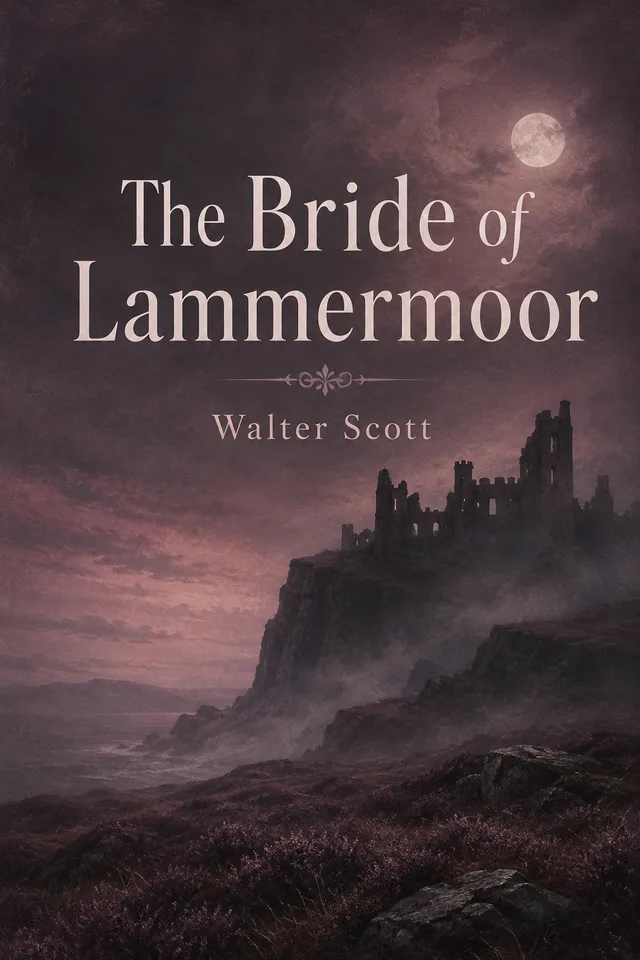
The Bride of Lammermoor
English BooksWhale Edition by Walter Scott
A tragic Scott romance of family feud, doomed love, political ambition, and Scottish Gothic atmosphere.
- Preview
- A sample from the prepared text
- Formats
- Online reader, EPUB, PDF
- Access
- Library claim
Book introduction
The Bride of Lammermoor
The Bride of Lammermoor tells the fatal story of Lucy Ashton and Edgar Ravenswood, whose love is crushed by family rivalry, property politics, and social pressure. Scott creates a dark Scottish romance of prophecy, ambition, madness, and doom.
BooksWhale edition
How this edition was prepared
This edition is based on a public domain text and has been prepared for digital reading by BooksWhale.
Public domain basis
Why this edition can be shared
Walter Scott died in 1832, and The Bride of Lammermoor was first published in 1819; these dates support the public-domain basis for the original English text.
Read preview
A sample from the prepared text
Preview selected from the prepared reader text.
Preview chapterFull textRead preview
The Bride of Lammermoor
Walter Scott
Preview chapterINTRODUCTION TO THE BRIDE OF LAMMERMOORPreview
The author, on a former occasion, declined giving the real source from which he drew the tragic subject of this history, because, though occurring at a distant period, it might possibly be unpleasing to the feelings of the descendants of the parties. But as he finds an account of the circumstances given in the Notes to Law’s Memorials, by his ingenious friend, Charles Kirkpatrick Sharpe, Esq., and also indicated in his reprint of the Rev. Mr. Symson’s poems appended to the Large Description of Galloway, as the original of the Bride of Lammermoor, the author feels himself now at liberty to tell the tale as he had it from connexions of his own, who lived very near the period, and were closely related to the family of the bride.
It is well known that the family of Dalrymple, which has produced, within the space of two centuries, as many men of talent, civil and military, and of literary, political, and professional eminence, as any house in Scotland, first rose into distinction in the person of James Dalrymple, one of the most eminent lawyers that ever lived, though the labours of his powerful mind were unhappily exercised on a subject so limited as Scottish jurisprudence, on which he has composed an admirable work.
He married Margaret, daughter to Ross of Balneel, with whom he obtained a considerable estate. She was an able, politic, and high-minded woman, so successful in what she undertook, that the vulgar, no way partial to her husband or her family, imputed her success to necromancy. According to the popular belief, this Dame Margaret purchased the temporal prosperity of her family from the Master whom she served under a singular condition, which is thus narrated by the historian of her grandson, the great Earl of Stair: “She lived to a great age, and at her death desired that she might not be put under ground, but that her coffin should stand upright on one end of it, promising that while she remained in that situation the Dalrymples should continue to flourish. What was the old lady’s motive for the request, or whether she really made such a promise, I shall not take upon me to determine; but it’s certain her coffin stands upright in the isle of the church of Kirklistown, the burial-place belonging to the family.” The talents of this accomplished race were sufficient to have accounted for the dignities which many members of the family attained, without any supernatural assistance. But their extraordinary prosperity was attended by some equally singular family misfortunes, of which that which befell their eldest daughter was at once unaccountable and melancholy.
Miss Janet Dalrymple, daughter of the first Lord Stair and Dame Margaret Ross, had engaged herself without the knowledge of her parents to the Lord Rutherford, who was not acceptable to them either on account of his political principles or his want of fortune. The young couple broke a piece of gold together, and pledged their troth in the most solemn manner; and it is said the young lady imprecated dreadful evils on herself should she break her plighted faith. Shortly after, a suitor who was favoured by Lord Stair, and still more so by his lady, paid his addresses to Miss Dalrymple. The young lady refused the proposal, and being pressed on the subject, confessed her secret engagement. Lady Stair, a woman accustomed to universal submission, for even her husband did not dare to contradict her, treated this objection as a trifle, and insisted upon her daughter yielding her consent to marry the new suitor, David Dunbar, son and heir to David Dunbar of Baldoon, in Wigtonshire. The first lover, a man of very high spirit, then interfered by letter, and insisted on the right he had acquired by his troth plighted with the young lady. Lady Stair sent him for answer, that her daughter, sensible of her undutiful behaviour in entering into a contract unsanctioned by her parents, had retracted her unlawful vow, and now refused to fulfil her engagement with him.
Preview chapterCHAPTER IPreview
By Cauk and keel to win your bread, Wi’ whigmaleeries for them wha need, Whilk is a gentle trade indeed To carry the gaberlunzie on.
Old Song.
Few have been in my secret while I was compiling these narratives, nor is it probable that they will ever become public during the life of their author. Even were that event to happen, I am not ambitious of the honoured distinction, _digito monstrari_. I confess that, were it safe to cherish such dreams at all, I should more enjoy the thought of remaining behind the curtain unseen, like the ingenious manager of Punch and his wife Joan, and enjoying the astonishment and conjectures of my audience. Then might I, perchance, hear the productions of the obscure Peter Pattieson praised by the judicious and admired by the feeling, engrossing the young and attracting even the old; while the critic traced their fame up to some name of literary celebrity, and the question when, and by whom, these tales were written filled up the pause of conversation in a hundred circles and coteries. This I may never enjoy during my lifetime; but farther than this, I am certain, my vanity should never induce me to aspire.
I am too stubborn in habits, and too little polished in manners, to envy or aspire to the honours assigned to my literary contemporaries. I could not think a whit more highly of myself were I found worthy to “come in place as a lion” for a winter in the great metropolis. I could not rise, turn round, and show all my honours, from the shaggy mane to the tufted tail, “roar you an’t were any nightingale,” and so lie down again like a well-behaved beast of show, and all at the cheap and easy rate of a cup of coffee and a slice of bread and butter as thin as a wafer. And I could ill stomach the fulsome flattery with which the lady of the evening indulges her show-monsters on such occasions, as she crams her parrots with sugar-plums, in order to make them talk before company. I cannot be tempted to “come aloft” for these marks of distinction, and, like imprisoned Samson, I would rather remain—if such must be the alternative—all my life in the mill-house, grinding for my very bread, than be brought forth to make sport for the Philistine lords and ladies. This proceeds from no dislike, real or affected, to the aristocracy of these realms. But they have their place, and I have mine; and, like the iron and earthen vessels in the old fable, we can scarce come into collision without my being the sufferer in every sense. It may be otherwise with the sheets which I am now writing. These may be opened and laid aside at pleasure; by amusing themselves with the perusal, the great will excite no false hopes; by neglecting or condemning them, they will inflict no pain; and how seldom can they converse with those whose minds have toiled for their delight without doing either the one or the other.
In the better and wiser tone of feeling, which Ovid only expresses in one line to retract in that which follows, I can address these quires—
Parve, nec invideo, sine me, liber, ibis in urbem.
Nor do I join the regret of the illustrious exile, that he himself could not in person accompany the volume, which he sent forth to the mart of literature, pleasure, and luxury. Were there not a hundred similar instances on record, the rate of my poor friend and school-fellow, Dick Tinto, would be sufficient to warn me against seeking happiness in the celebrity which attaches itself to a successful cultivator of the fine arts.
Dick Tinto, when he wrote himself artist, was wont to derive his origin from the ancient family of Tinto, of that ilk, in Lanarkshire, and occasionally hinted that he had somewhat derogated from his gentle blood in using the pencil for his principal means of support. But if Dick’s pedigree was correct, some of his ancestors must have suffered a more heavy declension, since the good man his father executed the necessary, and, I trust, the honest, but certainly not very distinguished, employment of tailor in ordinary to the village of Langdirdum in the west. Under his humble roof was Richard born, and to his father’s humble trade was Richard, greatly contrary to his inclination, early indentured. Old Mr. Tinto had, however, no reason to congratulate himself upon having compelled the youthful genius of his son to forsake its natural bent. He fared like the school-boy who attempts to stop with his finger the spout of a water cistern, while the stream, exasperated at this compression, escapes by a thousand uncalculated spurts, and wets him all over for his pains. Even so fared the senior Tinto, when his hopeful apprentice not only exhausted all the chalk in making sketches upon the shopboard, but even executed several caricatures of his father’s best customers, who began loudly to murmur, that it was too hard to have their persons deformed by the vestments of the father, and to be at the same time turned into ridicule by the pencil of the son. This led to discredit and loss of practice, until the old tailor, yielding to destiny and to the entreaties of his son, permitted him to attempt his fortune in a line for which he was better qualified.
Table of contents
Inside this edition
- 01Full text
- 02INTRODUCTION TO THE BRIDE OF LAMMERMOOR
- 03CHAPTER I
- 04CHAPTER II.
- 05CHAPTER III.
- 06CHAPTER IV.
- 07SPENSER.
- 08CHAPTER V.
- 09SHAKESPEARE
- 10CHAPTER VI.
- 11HENRY MACKENZIE.
- 12CHAPTER VII.
- 13CHAPTER VIII.
- 14“RIGHT HONOURABLE OUR COUSIN:
- 15CHAPTER IX.
- 16CHAPTER X.
- 17CHAPTER XI.
- 18CHAPTER XII.
- 19CHAPTER XIII.
- 20CHAPTER XIV.
- 21ANONYMOUS.
- 22CHAPTER XV.
- 23CHAPTER XVI.
- 24CHAPTER XVII.
- 25ANONYMOUS.
- 26CHAPTER XVIII.
- 27CHAPTER XIX.
- 28CHAPTER XX.
- 29WORDSWORTH.
- 30CHAPTER XXI.
- 31CHAPTER XXII.
- 32CHAPTER XXIII.
- 33WALLER
- 34CHAPTER XXIV.
- 35CHAPTER XXV.
- 36HENDERSOUN.
- 37CHAPTER XXVI.
- 38CAMPBELL.
- 39CHAPTER XXVII.
- 40CHAPTER XXVIII.
- 41CHAPTER XXIX.
- 42CHAPTER XXX.
- 43CHAPTER XXXI.
- 44CHAPTER XXXII.
- 45CRABBE.
- 46CHAPTER XXXIII.
- 47CHAPTER XXXIV.
- 48CHAPTER XXXV.
Language availability
Other languages
Additional language editions are not published yet. This section will link to other BooksWhale editions when they become available.
Request another language