English Edition
Education
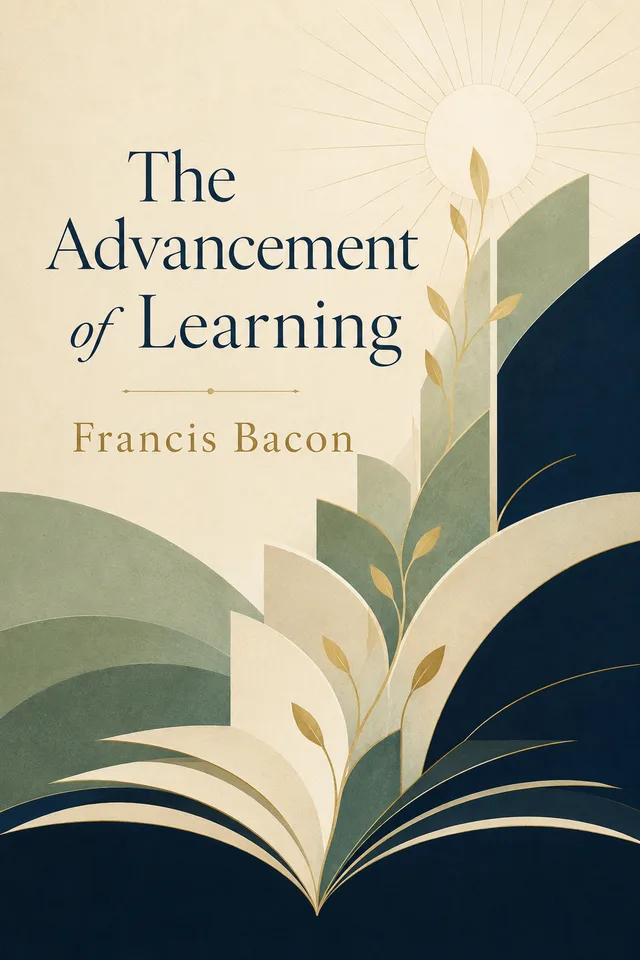
The Advancement of Learning
English BooksWhale Edition by Francis Bacon
Bacon’s program for organizing knowledge, reforming study, and advancing useful learning.
- Preview
- A sample from the prepared text
- Formats
- Online reader, EPUB, PDF
- Access
- Library claim
Book introduction
The Advancement of Learning
The Advancement of Learning maps the branches of knowledge and argues for a renewed culture of inquiry, experiment, and public usefulness. Bacon’s prose helped shape modern education, scientific method, institutional learning, and the idea of knowledge as a collective human project.
BooksWhale edition
How this edition was prepared
This edition is based on a public domain text and has been prepared for digital reading by BooksWhale.
Public domain basis
Why this edition can be shared
The Advancement of Learning is a public-domain work: the author died in 1626, and the text was first published in 1605. This edition uses the original English text.
Read preview
A sample from the prepared text
Preview selected from the prepared reader text.
Preview chapterThe Advancement of LearningRead preview
ccx074@pglaf.org
Changed “considering that the most barbarous, rude, and unlearned
times have been most subject to tumults, seditious, and changes” to
“considering that the most barbarous, rude, and unlearned times have
been most subject to tumults, seditions, and changes”.
CASSELL’S NATIONAL LIBRARY.
THE
ADVANCEMENT
OF
LEARNING.
BY
FRANCIS BACON.
[Picture: Decorative graphic]
CASSELL & COMPANY, Limited:
_LONDON_, _PARIS & MELBOURNE_.
1893.
INTRODUCTION.
“THE TVVOO Bookes of Francis Bacon. Of the proficience and aduancement
of Learning, divine and humane. To the King. At London. Printed for
Henrie Tomes, and are to be sould at his shop at Graies Inne Gate in
Holborne. 1605.” That was the original title-page of the book now in
the reader’s hand—a living book that led the way to a new world of
thought. It was the book in which Bacon, early in the reign of James the
First, prepared the way for a full setting forth of his New Organon, or
instrument of knowledge.
The Organon of Aristotle was a set of treatises in which Aristotle had
written the doctrine of propositions. Study of these treatises was a
chief occupation of young men when they passed from school to college,
and proceeded from Grammar to Logic, the second of the Seven Sciences.
Francis Bacon as a youth of sixteen, at Trinity College, Cambridge, felt
the unfruitfulness of this method of search after truth. He was the son
of Sir Nicholas Bacon, Queen Elizabeth’s Lord Keeper, and was born at
York House, in the Strand, on the 22nd of January, 1561. His mother was
the Lord Keeper’s second wife, one of two sisters, of whom the other
married Sir William Cecil, afterwards Lord Burleigh. Sir Nicholas Bacon
had six children by his former marriage, and by his second wife two sons,
Antony and Francis, of whom Antony was about two years the elder. The
family home was at York Place, and at Gorhambury, near St. Albans, from
which town, in its ancient and its modern style, Bacon afterwards took
his titles of Verulam and St. Albans.
Antony and Francis Bacon went together to Trinity College, Cambridge,
when Antony was fourteen years old and Francis twelve. Francis remained
at Cambridge only until his sixteenth year; and Dr. Rawley, his chaplain
in after-years, reports of him that “whilst he was commorant in the
University, about sixteen years of age (as his lordship hath been pleased
to impart unto myself), he first fell into dislike of the philosophy of
Aristotle; not for the worthlessness of the author, to whom he would
ascribe all high attributes, but for the unfruitfulness of the way, being
a philosophy (as his lordship used to say) only strong for disputatious
and contentions, but barren of the production of works for the benefit of
the life of man; in which mind he continued to his dying day.” Bacon was
sent as a youth of sixteen to Paris with the ambassador Sir Amyas Paulet,
to begin his training for the public service; but his father’s death, in
February, 1579, before he had completed the provision he was making for
his youngest children, obliged him to return to London, and, at the age
of eighteen, to settle down at Gray’s Inn to the study of law as a
profession. He was admitted to the outer bar in June, 1582, and about
that time, at the age of twenty-one, wrote a sketch of his conception of
a New Organon that should lead man to more fruitful knowledge, in a
little Latin tract, which he called “Temporis Partus Maximus” (“The
Greatest Birth of Time”).
In November, 1584, Bacon took his seat in the House of Commons as member
for Melcombe Regis, in Dorsetshire. In October, 1586, he sat for
Taunton. He was member afterwards for Liverpool; and he was one of those
who petitioned for the speedy execution of Mary Queen of Scots. In
Preview chapterbook, excellently discerning that matter of manifest truth, suchPreview
whereupon observation and rule was to be built, was not to be mingled or
weakened with matter of doubtful credit; and yet again, that rarities and
reports that seem uncredible are not to be suppressed or denied to the
memory of men.
(11) And as for the facility of credit which is yielded to arts and
opinions, it is likewise of two kinds; either when too much belief is
attributed to the arts themselves, or to certain authors in any art. The
sciences themselves, which have had better intelligence and confederacy
with the imagination of man than with his reason, are three in number:
astrology, natural magic, and alchemy; of which sciences, nevertheless,
the ends or pretences are noble. For astrology pretendeth to discover
that correspondence or concatenation which is between the superior globe
and the inferior; natural magic pretendeth to call and reduce natural
philosophy from variety of speculations to the magnitude of works; and
alchemy pretendeth to make separation of all the unlike parts of bodies
which in mixtures of natures are incorporate. But the derivations and
prosecutions to these ends, both in the theories and in the practices,
are full of error and vanity; which the great professors themselves have
sought to veil over and conceal by enigmatical writings, and referring
themselves to auricular traditions and such other devices, to save the
credit of impostures. And yet surely to alchemy this right is due, that
it may be compared to the husbandman whereof Æsop makes the fable; that,
when he died, told his sons that he had left unto them gold buried
underground in his vineyard; and they digged over all the ground, and
gold they found none; but by reason of their stirring and digging the
mould about the roots of their vines, they had a great vintage the year
following: so assuredly the search and stir to make gold hath brought to
light a great number of good and fruitful inventions and experiments, as
well for the disclosing of nature as for the use of man’s life.
(12) And as for the overmuch credit that hath been given unto authors in
sciences, in making them dictators, that their words should stand, and
not consuls, to give advice; the damage is infinite that sciences have
received thereby, as the principal cause that hath kept them low at a
stay without growth or advancement. For hence it hath come, that in arts
mechanical the first deviser comes shortest, and time addeth and
perfecteth; but in sciences the first author goeth furthest, and time
leeseth and corrupteth. So we see artillery, sailing, printing, and the
like, were grossly managed at the first, and by time accommodated and
refined; but contrariwise, the philosophies and sciences of Aristotle,
Plato, Democritus, Hippocrates, Euclides, Archimedes, of most vigour at
the first, and by time degenerate and imbased: whereof the reason is no
other, but that in the former many wits and industries have contributed
in one; and in the latter many wits and industries have been spent about
the wit of some one, whom many times they have rather depraved than
illustrated; for, as water will not ascend higher than the level of the
first spring-head from whence it descendeth, so knowledge derived from
Aristotle, and exempted from liberty of examination, will not rise again
higher than the knowledge of Aristotle. And, therefore, although the
position be good, _Oportet discentem credere_, yet it must be coupled
with this, _Oportet edoctum judicare_; for disciples do owe unto masters
only a temporary belief and a suspension of their own judgment till they
be fully instructed, and not an absolute resignation or perpetual
captivity; and therefore, to conclude this point, I will say no more, but
so let great authors have their due, as time, which is the author of
authors, be not deprived of his due—which is, further and further to
discover truth. Thus have I gone over these three diseases of learning;
Preview chapterbook entitled _Cærsares_, being as a pasquil or satire to deride all hisPreview
predecessors, feigned that they were all invited to a banquet of the
gods, and Silenus the jester sat at the nether end of the table and
bestowed a scoff on everyone as they came in; but when Marcus Philosophus
came in, Silenus was gravelled and out of countenance, not knowing where
to carp at him, save at the last he gave a glance at his patience towards
his wife. And the virtue of this prince, continued with that of his
predecessor, made the name of Antoninus so sacred in the world, that
though it were extremely dishonoured in Commodus, Caracalla, and
Heliogabalus, who all bare the name, yet, when Alexander Severus refused
the name because he was a stranger to the family, the Senate with one
acclamation said, _Quomodo Augustus_, _sic et Antoninus_. In such renown
and veneration was the name of these two princes in those days, that they
would have had it as a perpetual addition in all the emperors’ style. In
this emperor’s time also the Church for the most part was in peace; so as
in this sequence of six princes we do see the blessed effects of learning
in sovereignty, painted forth in the greatest table of the world.
(9) But for a tablet or picture of smaller volume (not presuming to speak
of your Majesty that liveth), in my judgment the most excellent is that
of Queen Elizabeth, your immediate predecessor in this part of Britain; a
prince that, if Plutarch were now alive to write lives by parallels,
would trouble him, I think, to find for her a parallel amongst women.
This lady was endued with learning in her sex singular, and rare even
amongst masculine princes—whether we speak of learning, of language, or
of science, modern or ancient, divinity or humanity—and unto the very
last year of her life she accustomed to appoint set hours for reading,
scarcely any young student in a university more daily or more duly. As
for her government, I assure myself (I shall not exceed if I do affirm)
that this part of the island never had forty-five years of better tines,
and yet not through the calmness of the season, but through the wisdom of
her regiment. For if there be considered, of the one side, the truth of
religion established, the constant peace and security, the good
administration of justice, the temperate use of the prerogative, not
slackened, nor much strained; the flourishing state of learning, sortable
to so excellent a patroness; the convenient estate of wealth and means,
both of crown and subject; the habit of obedience, and the moderation of
discontents; and there be considered, on the other side, the differences
of religion, the troubles of neighbour countries, the ambition of Spain,
and opposition of Rome, and then that she was solitary and of herself;
these things, I say, considered, as I could not have chosen an instance
so recent and so proper, so I suppose I could not have chosen one more
remarkable or eminent to the purpose now in hand, which is concerning the
conjunction of learning in the prince with felicity in the people.
(10) Neither hath learning an influence and operation only upon civil
merit and moral virtue, and the arts or temperature of peace and
peaceable government; but likewise it hath no less power and efficacy in
enablement towards martial and military virtue and prowess, as may be
notably represented in the examples of Alexander the Great and Cæsar the
Dictator (mentioned before, but now in fit place to be resumed), of whose
virtues and acts in war there needs no note or recital, having been the
wonders of time in that kind; but of their affections towards learning
and perfections in learning it is pertinent to say somewhat.
(11) Alexander was bred and taught under Aristotle, the great
philosopher, who dedicated divers of his books of philosophy unto him; he
Table of contents
Inside this edition
- 01The Advancement of Learning
- 02book, excellently discerning that matter of manifest truth, such
- 03book entitled _Cærsares_, being as a pasquil or satire to deride all his
- 04book.
Language availability
Other languages
Additional language editions are not published yet. This section will link to other BooksWhale editions when they become available.
Request another language