English Edition
Literature
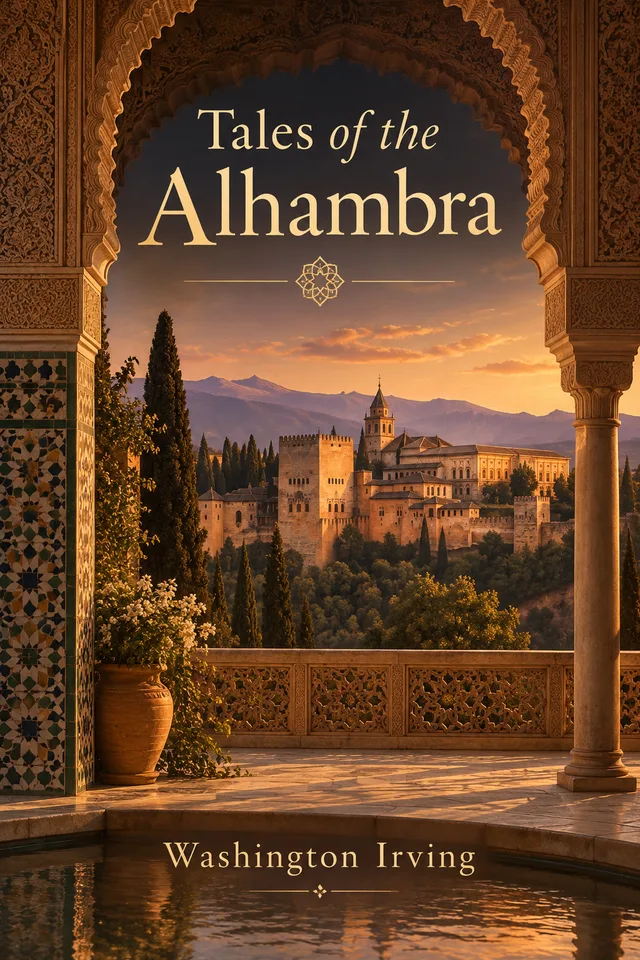
Tales of the Alhambra
English BooksWhale Edition by Washington Irving
Legends, travelers’ sketches and Moorish memories gathered around Granada’s palace-fortress.
- Preview
- A sample from the prepared text
- Formats
- Online reader, EPUB, PDF
- Access
- Library claim
Book introduction
Tales of the Alhambra
Legends, travelers’ sketches and Moorish memories gathered around Granada’s palace-fortress. Washington Irving’s celebrated Granada book blends travel writing, Moorish legends, local history and the atmosphere of the Alhambra.
BooksWhale edition
How this edition was prepared
This edition is based on a public domain text and has been prepared for digital reading by BooksWhale.
Public domain basis
Why this edition can be shared
Washington Irving died in 1859; the 1832 travel and legend collection is public domain.
Read preview
A sample from the prepared text
Preview selected from the prepared reader text.
Preview chapterFull textRead preview
Tales of the Alhambra
Washington Irving
Preview chapterTHE ALHAMBRAPreview
Washington Irving's rooms, overlooking the Garden of Lindaraxa.
THE ALHAMBRA BY · WASHINGTON · IRVING WITH AN INTRODUCTION BY ELIZABETH ROBINS PENNELL ILLUSTRATED WITH DRAWINGS OF THE PLACES MENTIONED BY JOSEPH PENNELL
Preview chapterINTRODUCTIONPreview
It is not possible to forget Washington Irving in the Alhambra. With a single volume, the simple, gentle, kindly American man of letters became no less a figure in the Moor's Red Palace than Boabdil and Lindaraxa of whom he wrote. And yet, never perhaps did a book make so unconscious a bid for popularity. Irving visited Granada in 1828. He returned the following year, when the Governor's apartments in the Alhambra were lent to him as lodgings. There he spent several weeks, his love for the place growing with every day and hour. It was this affection, and no more complex motive, that prompted him to describe its courts and gardens and to record its legends. The work was the amusement of his leisure moments, filling the interval between the completion of one serious, and now all but unknown, history and the beginning of the next.
Not many other men just then could write about Spain or anything Spanish so naturally. For, in 1829, while, within the walls of Alhamar and Yusef, he was listening to the prattle of Mateo and Dolores, in Paris, Alfred de Musset was writing his Contes d'Espagne, and Victor Hugo was publishing a new edition of his Orientales. A year later and the battle of Hernani was to be fought at the Comédie Française; a few more, and Théophile Gautier would be on his way across the Pyrenees. Time had passed since Châteaubriand, the pioneer of romance, could dismiss the Alhambra with a word. Hugo, in turning all eyes to the East, had declared that Spain also was Oriental, and to his disciples the journey, dreamed or made, through the land where Irving travelled in single-minded enjoyment, was an excuse for the profession of their literary faith. Irving, whatever his accomplishments, was unencumbered with a mission and innocent of pose. There is no reason to believe that he had ever heard of the Romanticists, or the part Spain was playing in the revolution; though he had been in Paris when the storm was brewing; though he returned after the famous red waistcoat had been sported in the public's face. At any rate, like the original genius of to-day, he kept his knowledge to himself.
Literary work took Irving to Spain. Several years before, in 1818, he had watched the total wreck of his brother's business. This was the second event of importance in his hitherto mild and colourless existence. The first had been the death of the girl he was to marry, a loss which left him without interest or ambition. There was then no need for him to work, and his health was delicate. He travelled a little: an intelligent, sympathetic and observant tourist. He wrote a little, discovering that he was an author with Knickerbocker. But his writing was of the desultory sort until, when he was thirty-five years old, his brother's failure forced him to make literature his profession. It was after he had published his Sketch-Book and Bracebridge Hall and Old Christmas, after their reception had been of the kind to satisfy even the present generation of writers who measure the excellence of work by the price paid for it, that some one suggested he should translate the journeys of Columbus, which Navarrete, a Spanish author, had in hand. Murray, it was thought, would give a handsome sum down for the translation. Murray himself, however, was not so sure: wanted, wise man, first to see a portion of the manuscript. This was just what could not be until Irving had begun his task. But already in Madrid, and assured of nothing, he found the rôle of translator less congenial than that of historian, and the Spanish work eventually resolved itself into his Life of Columbus. "Delving in the rich ore" of the old chronicles in the Jesuits' Library of St. Isidoro, there was one side issue in the history he was studying that enchanted him above all else. This was the Conquest of Granada, the brilliant episode which had fascinated him ever since, as a boy at play on the banks of the Hudson, his allegiance had been divided between the Spanish cavalier, in gold and silver armour, prancing over the Vega, and the Red Indian brandishing his tomahawk on the war-path. Now, occasionally, Columbus was forgotten that he might collect the materials for a new story of the Conquest to be told by himself. To consult further documents he started one spring (1828), when the almond trees were blossoming, for Andalusia; and Granada, of course, came into his journey. Thus chance brought him to the Alhambra, while (1829) the courtesy of the Governor and the kindness of old Tia Antonia put him in possession of the rooms of the beautiful Elizabeth of Parma, overlooking the oranges and fountains of the Garden of Lindaraxa.
Table of contents
Inside this edition
- 01Full text
- 02THE ALHAMBRA
- 03INTRODUCTION
- 04THE JOURNEY
- 05PALACE OF THE ALHAMBRA
- 06IMPORTANT NEGOTIATIONS.—THE AUTHOR SUCCEEDS TO THE THRONE OF BOABDIL
- 07INHABITANTS OF THE ALHAMBRA
- 08THE HALL OF AMBASSADORS
- 09THE MYSTERIOUS CHAMBERS
- 10PANORAMA FROM THE TOWER OF COMARES
- 11THE BALCONY
- 12THE ADVENTURE OF THE MASON
- 13THE COURT OF LIONS
- 14MEMENTOES OF BOABDIL
- 15THE HOUSE OF THE WEATHERCOCK
- 16LEGEND OF THE ARABIAN ASTROLOGER.
- 17VISITORS TO THE ALHAMBRA
- 18THE GENERALIFE
- 19LEGEND OF PRINCE AHMED AL KAMEL; OR, THE PILGRIM OF LOVE
- 20A RAMBLE AMONG THE HILLS
- 21LEGEND OF THE MOOR'S LEGACY
- 22THE TOWER OF LAS INFANTAS
- 23LEGEND OF THE THREE BEAUTIFUL PRINCESSES
- 24LEGEND OF THE ROSE OF THE ALHAMBRA
- 25THE VETERAN
- 26THE GOVERNOR AND THE NOTARY
- 27GOVERNOR MANCO AND THE SOLDIER
- 28A FÊTE IN THE ALHAMBRA
- 29LEGEND OF THE TWO DISCREET STATUES
- 30THE CRUSADE OF THE GRAND MASTER OF ALCÁNTARA
- 31AN EXPEDITION IN QUEST OF A DIPLOMA
- 32THE LEGEND OF THE ENCHANTED SOLDIER
- 33THE AUTHOR'S FAREWELL TO GRANADA
- 34FOOTNOTES
Language availability
Other languages
Additional language editions are not published yet. This section will link to other BooksWhale editions when they become available.
Request another language