English Edition
Literature
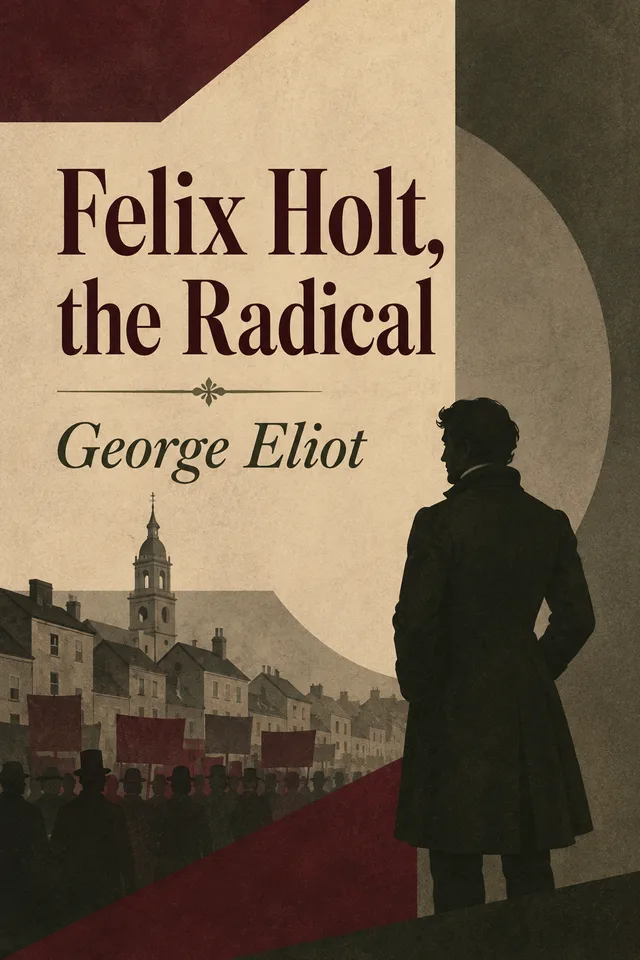
Felix Holt, the Radical
English BooksWhale Edition by George Eliot
A political and social novel about reform, inheritance, conscience, and class conflict.
- Preview
- A sample from the prepared text
- Formats
- Online reader, EPUB, PDF
- Access
- Library claim
Book introduction
Felix Holt, the Radical
Felix Holt, the Radical sets George Eliot’s moral realism against the turbulence of English electoral reform. Through Felix Holt, Esther Lyon, family secrets, legal inheritance, dissenting religion, and working-class politics, the novel explores conscience, social ambition, democratic change, and the cost of political idealism in provincial England.
BooksWhale edition
How this edition was prepared
This edition is based on a public domain text and has been prepared for digital reading by BooksWhale.
Public domain basis
Why this edition can be shared
George Eliot died in 1880, and Felix Holt, the Radical was published in 1866; these dates support public-domain status.
Read preview
A sample from the prepared text
Preview selected from the prepared reader text.
Preview chapterFull textRead preview
Felix Holt, the Radical
George Eliot
Preview chapterINTRODUCTION.Preview
Five-and-thirty years ago the glory had not yet departed from the old coach roads: the great roadside inns were still brilliant with well-polished tankards, the smiling glances of pretty barmaids, and the repartees of jocose hostlers; the mail still announced itself by the merry notes of the horn; the hedge-cutter or the rick-thatcher might still know the exact hour by the unfailing yet otherwise meteoric apparition of the pea-green Tally-ho or the yellow Independent; and elderly gentlemen in pony-chaises, quartering nervously to make way for the rolling, swinging swiftness, had not ceased to remark that times were finely changed since they used to see the pack-horses and hear the tinkling of their bells on this very highway.
In those days there were pocket boroughs, a Birmingham unrepresented in Parliament and compelled to make strong representations out of it, unrepealed corn-laws, three-and-sixpenny letters, a brawny and many-breeding pauperism, and other departed evils; but there were some pleasant things, too, which have also departed. _Non omnia grandior ætas quæ fugiamus habet_, says the wise goddess: you have not the best of it in all things, O youngsters! the elderly man has his enviable memories, and not the least of them is the memory of a long journey in mid-spring or autumn on the outside of a stage coach. Posterity may be shot, like a bullet through a tube, by atmospheric pressure, from Winchester to Newcastle: that is a fine result to have among our hopes; but the slow, old fashioned way of getting from one end of our country to the other is the better thing to have in the memory. The tube-journey can never lend much to picture and narrative; it is as barren as an exclamatory O! Whereas, the happy outside passenger, seated on the box from the dawn to the gloaming, gathered enough stories of English life, enough of English labors in town and country, enough aspects of earth and sky, to make episodes for a modern Odyssey. Suppose only that his journey took him through that central plain, watered at one extremity by the Avon, at the other by the Trent. As the morning silvered the meadows with their long lines of bushy willows marking the water-courses, or burnished the golden corn-ricks clustered near the long roofs of some midland homestead, he saw the full-uddered cows driven from their pasture to the early milking. Perhaps it was the shepherd, head-servant of the farm, who drove them, his sheep-dog following with a heedless, unofficial air, as of a beadle in undress. The shepherd, with a slow and slouching walk, timed by the walk of grazing beasts, moved aside, as if unwillingly, throwing out a monosyllabic hint to his cattle; his glance, accustomed to rest on things very near the earth, seemed to lift itself with difficulty to the coachman. Mail or stage coach for him belonged to the mysterious distant system of things called "Gover'ment," which, whatever it might be, was no business of his, any more than the most outlying nebula or the coal-sacks of the southern hemisphere: his solar system was the parish; the master's temper and the casualties of lambing-time were his region of storms. He cut his bread and bacon with his pocket-knife, and felt no bitterness except in the matter of pauper laborers and the bad-luck that sent contrarious seasons and the sheep-rot. He and his cows were soon left behind, and the homestead, too, with its pond overhung by elder-trees, its untidy kitchen-garden and cone-shaped yew-tree arbor. But everywhere the bushy hedgerows wasted the land with their straggling beauty, shrouded the grassy borders of the pastures with catkined hazels, and tossed their long blackberry branches on the corn-fields. Perhaps they were white with May, or starred with pale pink dog-roses; perhaps the urchins were already nutting among them, or gathering the plenteous crabs. It was worth the journey only to see those hedgerows, the liberal homes of unmarketable beauty--of the purple blossomed, ruby-berried nightshade, of the wild convolvulus climbing and spreading in tendriled strength till it made a great curtain of pale-green hearts and white trumpets, of the many-tubed honey-suckle which, in its most delicate fragrance, hid a charm more subtle and penetrating than beauty. Even if it were winter, the hedgerows showed their coral, the scarlet haws, the deep-crimson hips, with lingering brown leaves to make a resting-place for the jewels of the hoar-frost. Such hedgerows were often as tall as the laborers' cottages dotted along the lanes, or clustered into a small hamlet, their little dingy windows telling, like thick-filmed eyes, of nothing but the darkness within. The passenger on the coach-box, bowled along above such a hamlet, saw chiefly the roofs of it: probably it turned its back on the road, and seemed to lie away from everything but its own patch of earth and sky, away from the parish church by long fields and green lanes, away from all intercourse except that of tramps. If its face could be seen, it was most likely dirty; but the dirt was Protestant dirt, and the big, bold, gin-breathing tramps were Protestant tramps. There was no sign of superstition near, no crucifix or image to indicate a misguided reverence: the inhabitants were probably so free from superstition that they were in much less awe of the parson than of the overseer. Yet they were saved from the excess of Protestantism by not knowing how to read, and by the absence of handlooms and mines to be the pioneers of Dissent: they were kept safely in the _via media_ of indifference, and could have registered themselves in the census by a big black mark as members of the Church of England.
Preview chapterCHAPTER I.Preview
He left me when the down upon his lip Lay like the shadow of a hovering kiss. "Beautiful mother, do not grieve," he said; "I will be great, and build our fortunes high. And you shall wear the longest train at court, And look so queenly, all the lords shall say, 'She is a royal changeling: there is some crown Lacks the right head, since hers wears naught but braids.'" O, he is coming now--but I am gray: And he----
On the first of September, in the memorable year 1832, some one was expected at Transome Court. As early as two o'clock in the afternoon the aged lodge-keeper had opened the heavy gate, green as the tree trunks were green with nature's powdery paint, deposited year after year. Already in the village of Little Treby, which lay on the side of a steep hill not far off the lodge-gates, the elder matrons sat in their best gowns at the few cottage doors bordering the road, that they might be ready to get up and make their courtesy when a travelling carriage should come in sight; and beyond the village several small boys were stationed on the look-out, intending to run a race to the barn-like old church, where the sexton waited in the belfry ready to set the one bell in joyful agitation just at the right moment.
The old lodge-keeper had opened the gate and left it in the charge of his lame wife, because he was wanted at the Court to sweep away the leaves, and perhaps to help in the stables. For though Transome Court was a large mansion, built in the fashion of Queen Anne's time, with a park and grounds as fine as any to be seen in Loamshire, there were very few servants about it. Especially, it seemed, there must be a lack of gardeners; for, except on the terrace surrounded with a stone parapet in front of the house, where there was a parterre, kept with some neatness, grass had spread itself over the gravel walks, and over all the low mounds once carefully cut as black beds for the shrubs and larger plants. Many of the windows had the shutters closed, and under the grand Scotch fir that stooped toward one corner, the brown fir-needles of many years lay in a small stone balcony in front of two such darkened windows. All round, both near and far, there were grand trees, motionless in the still sunshine, and, like all large motionless things, seemed to add to the stillness. Here and there a leaf fluttered down; petals fell in a silent shower; a heavy moth fluttered by, and, when it settled, seemed to fall wearily; the tiny birds alighted on the walks, and hopped about in perfect tranquillity; even a stray rabbit sat nibbling a leaf that was to its liking, in the middle of a grassy space, with an air that seemed quite impudent in so timid a creature. No sound was to be heard louder than a sleepy hum, and the soft monotony of running water hurrying on to the river that divided the park. Standing on the south or east side of the house, you would never have guessed that an arrival was expected.
But on the west side, where the carriage entrance was, the gates under the stone archway were thrown open; and so was the double door of the entrance-hall, letting in the warm light on the scagliola pillars, the marble statues, and the broad stone staircase, with its matting worn into large holes. And, stronger sign of expectation than all, from one of the doors that surrounded the entrance-hall, there came forth from time to time a lady, who walked lightly over the polished stone floor, and stood on the door-steps and watched and listened. She walked lightly, for her figure was slim and finely formed, though she was between fifty and sixty. She was a tall, proud-looking woman, with abundant gray hair, dark eyes and eyebrows, and a somewhat eagle-like yet not unfeminine face. Her tight-fitting black dress was much worn; the fine lace of her cuffs and collar, and of the small veil that fell backward over her high comb, was visibly mended; but rare jewels flashed on her hands, which lay on her folded black-clad arms like finely-cut onyx cameos.
Table of contents
Inside this edition
- 01Full text
- 02INTRODUCTION.
- 03CHAPTER I.
- 04CHAPTER II.
- 05CHAPTER III.
- 06CHAPTER IV.
- 07CHAPTER V.
- 08CHAPTER VI.
- 09CHAPTER VII.
- 10CHAPTER VIII.
- 11CHAPTER IX.
- 12CHAPTER X.
- 13CHAPTER XI.
- 14CHAPTER XII.
Language availability
Other languages
Additional language editions are not published yet. This section will link to other BooksWhale editions when they become available.
Request another language