英语 版本
文学
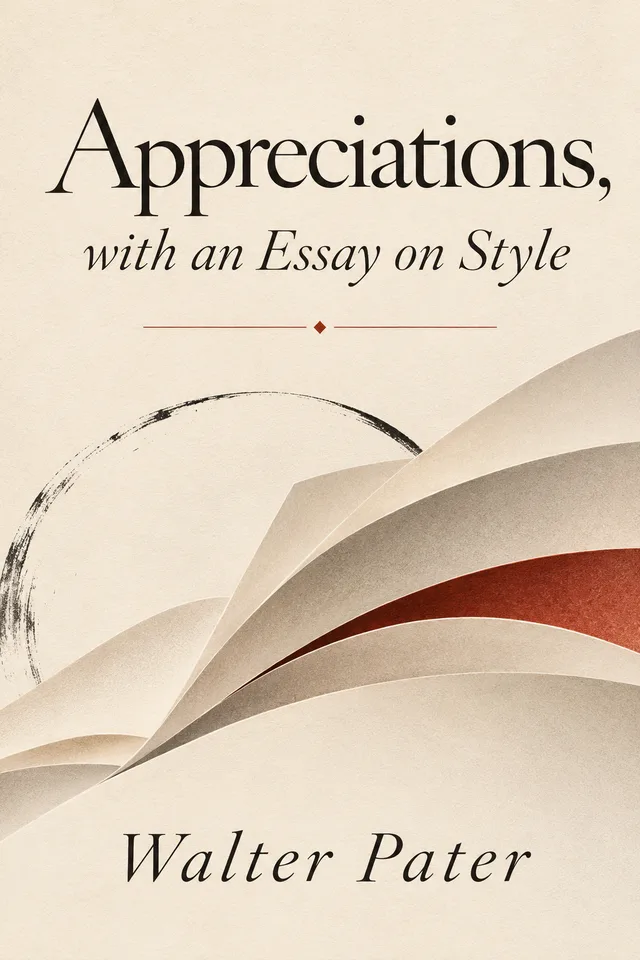
Appreciations, with an Essay on Style
英语 BooksWhale 版本 · Walter Pater
Walter Pater examines literary style through close readings of Wordsworth, Coleridge, Lamb, Browne, Shakespeare, Rossetti, and other writers.
- 预览
- 文本节选
- 格式
- 在线阅读, EPUB, PDF
- 访问
- Library 获取
图书简介
Appreciations, with an Essay on Style
Beginning with an essay on style, Walter Pater explores how literary language gives form to individual perception. His readings of English poets and prose writers attend to rhythm, intellectual temperament, imagination, and the relationship between thought and expression. Essays on Shakespeare and modern authors broaden the collection, offering sustained examples of aesthetic criticism rather than a chronological survey of literary history.
BooksWhale 版本
此版本如何整理
此版本基于公版文本,并由 BooksWhale 整理为适合数字阅读的版本。
公版依据
为什么此版本可以分享
Walter Pater died in 1894; this work was first published in 1889. This edition uses the public-domain English text, excluding modern editorial notes.
阅读预览
文本节选
预览选自整理后的阅读文本。
预览章节Full text阅读预览
Appreciations, with an Essay on Style
预览章节STYLE预览
SINCE all progress of mind consists for the most part in differentiation, in the resolution of an obscure and complex object into its component aspects, it is surely the stupidest of losses to confuse things which right reason has put asunder, to lose the sense of achieved distinctions, the distinction between poetry and prose, for instance, or, to speak more exactly, between the laws and characteristic excellences of verse and prose composition. On the other hand, those who have dwelt most emphatically on the distinction between prose and verse, prose and poetry, may sometimes have been tempted to limit the proper functions of prose too narrowly; and this again is at least false economy, as being, in effect, the renunciation of a certain means or faculty, in a world where after all we must needs make the most of things. Critical efforts to limit art a priori, by anticipations regarding the natural incapacity of the material with which this or that artist works, as the sculptor with solid form, or the prose-writer with the ordinary language of men, are always liable to be discredited by the facts of artistic production; and while prose is actually found to be a coloured thing with Bacon, picturesque with Livy and Carlyle, musical with Cicero and Newman, mystical and intimate with Plato and Michelet and Sir Thomas Browne, exalted or florid, it may be, with Milton and Taylor, it will be useless to protest that it can be nothing at all, except something very tamely and narrowly confined to mainly practical ends—a kind of "good round-hand;" as useless as the protest that poetry might not touch prosaic subjects as with Wordsworth, or an abstruse matter as with Browning, or treat contemporary life nobly as with Tennyson. In subordination to one essential beauty in all good literary style, in all literature as a fine art, as there are many beauties of poetry so the beauties of prose are many, and it is the business of criticism to estimate them as such; as it is good in the criticism of verse to look for those hard, logical, and quasi-prosaic excellences which that too has, or needs. To find in the poem, amid the flowers, the allusions, the mixed perspectives, of Lycidas for instance, the thought, the logical structure:—how wholesome! how delightful! as to identify in prose what we call the poetry, the imaginative power, not treating it as out of place and a kind of vagrant intruder, but by way of an estimate of its rights, that is, of its achieved powers, there.
Dryden, with the characteristic instinct of his age, loved to emphasise the distinction between poetry and prose, the protest against their confusion with each other, coming with somewhat diminished effect from one whose poetry was so prosaic. In truth, his sense of prosaic excellence affected his verse rather than his prose, which is not only fervid, richly figured, poetic, as we say, but vitiated, all unconsciously, by many a scanning line. Setting up correctness, that humble merit of prose, as the central literary excellence, he is really a less correct writer than he may seem, still with an imperfect mastery of the relative pronoun. It might have been foreseen that, in the rotations of mind, the province of poetry in prose would find its assertor; and, a century after Dryden, amid very different intellectual needs, and with the need therefore of great modifications in literary form, the range of the poetic force in literature was effectively enlarged by Wordsworth. The true distinction between prose and poetry he regarded as the almost technical or accidental one of the absence or presence of metrical beauty, or, say! metrical restraint; and for him the opposition came to be between verse and prose of course; but, as the essential dichotomy in this matter, between imaginative and unimaginative writing, parallel to De Quincey's distinction between "the literature of power and the literature of knowledge," in the former of which the composer gives us not fact, but his peculiar sense of fact, whether past or present.
预览章节WORDSWORTH预览
SOME English critics at the beginning of the present century had a great deal to say concerning a distinction, of much importance, as they thought, in the true estimate of poetry, between the Fancy, and another more powerful faculty—the Imagination. This metaphysical distinction, borrowed originally from the writings of German philosophers, and perhaps not always clearly apprehended by those who talked of it, involved a far deeper and more vital distinction, with which indeed all true criticism more or less directly has to do, the distinction, namely, between higher and lower degrees of intensity in the poet's perception of his subject, and in his concentration of himself upon his work. Of those who dwelt upon the metaphysical distinction between the Fancy and the Imagination, it was Wordsworth who made the most of it, assuming it as the basis for the final classification of his poetical writings; and it is in these writings that the deeper and more vital distinction, which, as I have said, underlies the metaphysical distinction, is most needed, and may best be illustrated.
For nowhere is there so perplexed a mixture as in Wordsworth's own poetry, of work touched with intense and individual power, with work of almost no character at all. He has much conventional sentiment, and some of that insincere poetic diction, against which his most serious critical efforts were directed: the reaction in his political ideas, consequent on the excesses of 1795, makes him, at times, a mere declaimer on moral and social topics; and he seems, sometimes, to force an unwilling pen, and write by rule. By making the most of these blemishes it is possible to obscure the true aesthetic value of his work, just as his life also, a life of much quiet delicacy and independence, might easily be placed in a false focus, and made to appear a somewhat tame theme in illustration of the more obvious parochial virtues. And those who wish to understand his influence, and experience his peculiar savour, must bear with patience the presence of an alien element in Wordsworth's work, which never coalesced with what is really delightful in it, nor underwent his special power. Who that values his writings most has not felt the intrusion there, from time to time, of something tedious and prosaic? Of all poets equally great, he would gain most by a skilfully made anthology. Such a selection would show, in truth, not so much what he was, or to himself or others seemed to be, as what, by the more energetic and fertile quality in his writings, he was ever tending to become. And the mixture in his work, as it actually stands, is so perplexed, that one fears to miss the least promising composition even, lest some precious morsel should be lying hidden within—the few perfect lines, the phrase, the single word perhaps, to which he often works up mechanically through a poem, almost the whole of which may be tame enough. He who thought that in all creative work the larger part was given passively, to the recipient mind, who waited so dutifully upon the gift, to whom so large a measure was sometimes given, had his times also of desertion and relapse; and he has permitted the impress of these too to remain in his work. And this duality there—the fitfulness with which the higher qualities manifest themselves in it, gives the effect in his poetry of a power not altogether his own, or under his control, which comes and goes when it will, lifting or lowering a matter, poor in itself; so that that old fancy which made the poet's art an enthusiasm, a form of divine possession, seems almost literally true of him.
This constant suggestion of an absolute duality between higher and lower moods, and the work done in them, stimulating one always to look below the surface, makes the reading of Wordsworth an excellent sort of training towards the things of art and poetry. It begets in those, who, coming across him in youth, can bear him at all, a habit of reading between the lines, a faith in the effect of concentration and collectedness of mind in the right appreciation of poetry, an expectation of things, in this order, coming to one by means of a right discipline of the temper as well as of the intellect. He meets us with the promise that he has much, and something very peculiar, to give us, if we will follow a certain difficult way, and seems to have the secret of a special and privileged state of mind. And those who have undergone his influence, and followed this difficult way, are like people who have passed through some initiation, a disciplina arcani, by submitting to which they become able constantly to distinguish in art, speech, feeling, manners, that which is organic, animated, expressive, from that which is only conventional, derivative, inexpressive.
目录
本版本内容
- 01Full text
- 02STYLE
- 03WORDSWORTH
- 04COLERIDGE
- 05CHARLES LAMB
- 06SIR THOMAS BROWNE
- 07"LOVE'S LABOURS LOST"
- 08"MEASURE FOR MEASURE"
- 09SHAKESPEARE'S ENGLISH KINGS
- 10DANTE GABRIEL ROSSETTI
- 11FEUILLET'S "LA MORTE"
- 12POSTSCRIPT